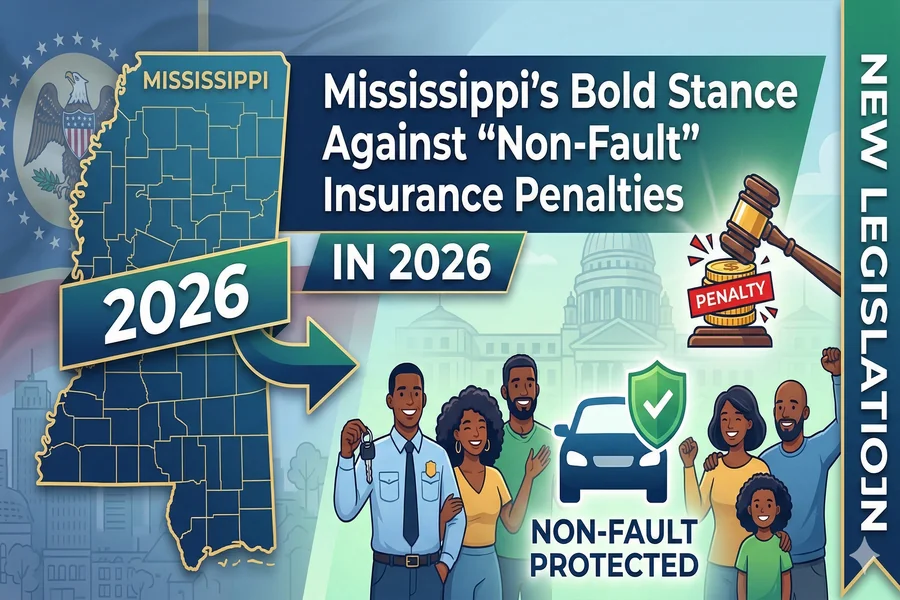
On the long, sun-drenched stretches of Highway 49 and the winding rural routes of the Mississippi Delta, the “Magnolia State” tells a story of motion, commerce, and, far too often, collision. For the average Mississippian, the car is not a luxury; it is a lifeline to work, school, and healthcare. Yet, that lifeline is increasingly entangled in a complex web of rising premiums, aggressive underwriting, and a legislative battle that could redefine the relationship between the insured and the insurer.
As the 2026 Regular Session of the Mississippi Legislature gains momentum, a new proposal—House Bill 1274—has emerged as a potential earthquake for the insurance industry. At its heart is a simple, yet provocative question: Should a driver be punished for an accident they did not cause?
The Collision Landscape in the Magnolia State
To understand the weight of House Bill 1274, one must first look at the asphalt. Mississippi consistently ranks among the states with the highest rates of fatal car accidents per capita. According to data from the Insurance Institute for Highway Safety (IIHS) and the Mississippi Department of Transportation, the state’s mix of high-speed rural roads, varying infrastructure quality, and a significant percentage of uninsured motorists creates a volatile environment for any driver.
In Mississippi, an accident claim is rarely “just” a claim. It is a financial cascade. When a collision occurs—whether it’s a T-bone at a Jackson intersection or a deer strike in the Piney Woods—the immediate concern is physical safety. But once the glass is cleared and the sirens fade, the secondary trauma begins: the claims process.
According to the Gardner Law Group, a Mississippi personal injury law firm, claims involving vehicular accidents are essentially complex:
“[For example], accident cases involving 18-wheelers and other large commercial trucks can become very complicated, because there are often multiple parties that are responsible.
“For example, an accident may be the fault of the driver, the trucking company, those who service the vehicle, the vehicle (or vehicle part) designer, manufacturer, supplier, or distributor, or more than one of these.”
For decades, Mississippi has operated under a traditional tort system, meaning someone is always “at fault.” However, the reality of the road is often muddier. Claims adjusters spend thousands of hours determining liability, and personal injury attorneys remain a staple of the local economy. From medical malpractice to workers’ compensation and, most frequently, auto accidents, the “claim” is the mechanism by which Mississippians seek to be made whole.
Yet, there is a growing sentiment among residents that “being made whole” is a disappearing prospect. Even when a driver is vindicated—when the police report clearly states they were a stationary victim or that the other party ran a red light—the financial repercussions often follow them home in the form of a “surcharge” or a “re-rating.”
The Social Contract of Insurance
This brings us to the fundamental importance of insurance. In a modern society, insurance is the invisible safety net that prevents a single bad second on the road from turning into a lifetime of debt. It is a risk-pooling mechanism where the many protect the few. We pay premiums with the understanding that in exchange for our monthly or bi-annual contribution, the carrier will bear the burden of catastrophic loss.
However, critics argue that the social contract is fraying. Insurance companies, driven by increasingly sophisticated data analytics and the need to satisfy shareholders, have moved toward “predictive modeling.” In these models, any involvement in an accident—regardless of fault—is statistically viewed as an indicator of future risk. To a computer algorithm, a driver who is hit three times by distracted teenagers is “accident-prone,” even if they were perfectly parked in their own driveway during every incident.
This practice has led to a “loyalty penalty” or a “victim tax.” For Mississippians living paycheck to paycheck, a 15% increase in an auto premium due to a non-fault accident can mean the difference between keeping the lights on or losing their mobility. It is this specific friction point that Representative Shanda Yates aims to lubricate—or perhaps more accurately, to strike with a legislative hammer.
House Bill 1274 – The “Triple Damages” Reckoning
Introduced during the 2026 Regular Session, House Bill 1274 is not a mere suggestion; it is a mandate with teeth. The bill takes direct aim at what it describes as unfair penalization of innocent drivers.
The Core Prohibition
Under the proposed law, auto insurers operating in Mississippi would be strictly prohibited from:
- Raising rates or premiums based on a non-fault incident.
- Applying surcharges to an existing policy.
- Canceling a policy solely due to a non-fault crash.
- Declining a renewal or steering a customer to a high-risk subsidiary because of an accident they didn’t cause.
The bill’s definition of a “non-fault incident” is intentionally broad. It covers any accident, collision, or incident involving a covered vehicle where the insured driver was not at fault. Crucially, the bill specifies that this protection applies regardless of whether police were called to the scene, placing the burden of proof on the insurer to justify any adverse action.
The Enforcement Mechanism: Triple Damages
What sets HB 1274 apart from similar consumer protection laws in other states is its aggressive enforcement. The Mississippi proposal doesn’t just ask for a refund; it demands a penalty.
If an insurer is found to have violated these rules, they are required to:
- Refund the overcharged premium.
- Pay a penalty of triple that amount, or $1,000, whichever is higher.
- Cover the policyholder’s attorney fees if the matter goes to court and the consumer wins.
This “triple damages” provision is designed to make the cost of non-compliance significantly higher than the potential profit from a premium hike. For an industry that manages millions of policies, the prospect of a $1,000 minimum penalty for every improperly applied surcharge represents a massive financial exposure.
A Sea Change for Underwriters
For the insurance industry, passage of this bill would necessitate a total architectural overhaul of their Mississippi operations. Currently, many insurers use “Comprehensive Loss Underwriting Exchange” (CLUE) reports, which list all claims associated with a driver. These reports often do not distinguish clearly between “at-fault” and “not-at-fault” in a way that excludes the latter from rating algorithms.
If HB 1274 becomes law, carriers would need to “scrub” non-fault data from their pricing engines entirely. This is a significant operational shift. It requires not just a change in policy, but a change in the code that determines what Mississippians pay.
Furthermore, the bill closes “affiliate loopholes.” In the past, some carriers might not cancel a policy but instead “transfer” a driver with a non-fault history to a secondary, more expensive company within the same corporate group. HB 1274 prohibits this “steering” unless the move is entirely unrelated to the non-fault history.
Transparency and the “Notice Loophole”
The legislation also addresses a common grievance among policyholders: the “sudden” non-renewal. Currently, insurers have a degree of flexibility in how and when they notify customers that their coverage is ending. HB 1274 seeks to tighten these requirements through amendments to Sections 83-11-3 and 83-11-7 of the Mississippi Code.
The bill establishes a two-tiered timeline for non-renewal notices:
- Before June 30, 2026: Insurers must provide at least 30 days of notice.
- After July 1, 2026: The notice period increases to 45 days.
But the real “bite” lies in the penalty for missing these deadlines. If an insurer fails to provide the required notice for a policy issued after July 1, 2026, the policyholder is granted a unique right: they can extend their coverage at the current premium rate for the duration of the notice period plus an additional 45 days. This cycle repeats every 45 days until the insurer finally delivers a legally compliant notice.
Essentially, a paperwork error by an insurance company could result in a driver receiving months of coverage at an old, lower rate—a “stay of execution” for the consumer’s wallet.
Part VI: Exceptions and the Industry’s Defense
Despite its aggressive nature, the bill is not a “free pass” for drivers. It preserves several standard industry protections. Insurers may still cancel or decline to renew policies for:
- Non-payment of premiums.
- Suspension or revocation of a driver’s license.
- Failure to maintain required memberships (such as in the Farm Bureau).
- Situations where the insured explicitly states they do not wish to renew.
The insurance industry is expected to argue that such a bill could have unintended consequences. Industry lobbyists often suggest that preventing insurers from using all available data—even non-fault data—leads to “rate compression.” They argue that if they cannot charge “riskier” (even if non-fault) drivers more, they must raise rates for everyone to maintain the same level of solvency.
However, proponents of the bill, including Representative Yates, argue that the current system is fundamentally unjust. They contend that an insurance company’s “solvency” should not be built on the backs of people who have done nothing wrong.
The Road Ahead
House Bill 1274 has been assigned to the House Insurance Committee. Its journey through the legislative gauntlet will be watched closely by consumer advocates and corporate lawyers alike. If it clears the committee and finds favor in both the House and Senate, it is slated to take effect on July 1, 2026.
For the citizens of Mississippi, the bill represents a rare moment of legislative focus on the “little guy.” It acknowledges that in the high-stakes game of road safety and financial stability, the consumer is often at a disadvantage when facing multi-billion dollar corporations armed with data and lawyers.
If passed, Mississippi would become a pioneer in aggressive insurance reform. The state would be sending a clear message: in the Magnolia State, innocence on the road is no longer a liability. The “Triple Damages” provision ensures that this isn’t just a change in the law—it’s a change in the power dynamic.
As Mississippians continue to navigate their daily commutes, the promise of HB 1274 offers a glimpse of a future where an accident—provided it wasn’t your fault—truly is just an accident, and not the beginning of a financial downward spiral. For now, the bill sits in committee, a dormant giant that, if awakened, will force the insurance industry to finally respect the distinction between the reckless and the unlucky.