You’ve got a product idea. Maybe you’ve been sitting on it for months. Now you’re finally ready to leap, but one question keeps stopping you in your tracks:
Which eCommerce platform should I build on?
It sounds like a technical decision. But it’s actually a business decision, one that affects how fast you launch, how easily you scale, and how much you spend along the way.
This guide breaks down the best eCommerce platforms in 2026 for every type of seller: first-timers figuring out where to start, small businesses ready to grow, and established brands thinking about switching.
Let’s get into it.
What Is an eCommerce Platform, and Why Does It Matter?
An eCommerce platform is the software that powers your online store. It handles everything from listing products and managing inventory to processing payments, handling shipping, and tracking orders, all from a single dashboard.
Think of it as the infrastructure beneath your entire online business.
Choose the right one, and it gets out of your way, letting you focus on selling. Choose the wrong one, and you’re fighting with it constantly: paying for workarounds, dealing with slow load times, or hitting walls every time you try to grow.
The platform you choose shapes your customer experience, marketing capabilities, operational costs, and long-term flexibility. It’s not a decision you want to revisit every year.
How to Actually Choose the Right Platform
Most comparison articles will tell you to consider pricing and ease of use. That’s true, but incomplete.
Here’s a more practical framework:
- Start with your technical comfort level: If you’ve never touched code, platforms like Shopify and Wix are built for you. If you’re comfortable with WordPress or have a developer on hand, WooCommerce opens up significantly more control.
- Think about where you’re headed, not just where you are: A platform that works fine for 50 orders a month can buckle at 500. Shopify and BigCommerce are designed with scale in mind. WooCommerce and Magento can scale, too, but they require more hands-on management as you grow.
- Don’t underestimate shipping: Shipping is one of the most overlooked factors when choosing a platform, and one of the most painful to fix later. Look for real-time carrier rates, label printing, multi-carrier support, and the ability to integrate with third-party shipping tools. This alone can save you hours of manual work every week.
- Factor in the total cost, not just the subscription fee: A “free” platform isn’t free if you’re spending $150/month on plugins to make it functional. Add up hosting, themes, extensions, and transaction fees before comparing sticker prices.
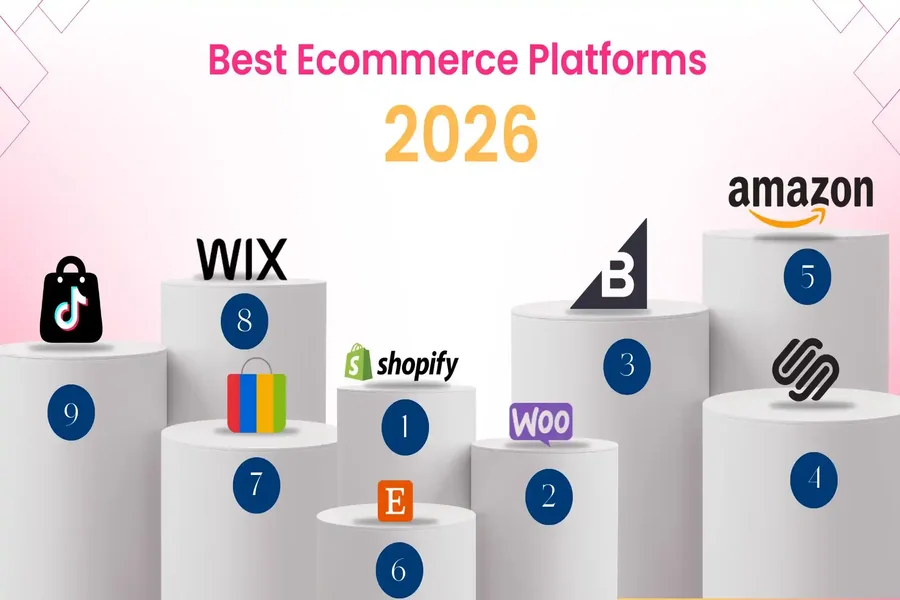
The Top 5 eCommerce Platforms in 2026
1. Shopify
Shopify has become the default choice for ambitious online retailers, and for good reason. It’s fast to launch, polished out of the box, and has one of the most powerful app ecosystems in eCommerce.
The platform now includes an AI-powered store setup that dramatically cuts the time to launch. Once you’re live, you get built-in payment processing (Shopify Payments), seamless multi-channel selling across Amazon, Instagram, and TikTok, and a deep library of shipping and fulfilment integrations from the third-party logistics connectors.
Where Shopify shines is in the middle stage of growth, when you’ve moved past scrappy startup mode but aren’t yet running a complex enterprise operation. It handles that range better than almost anything else.
Key Features:
- 8,000+ app ecosystem: One of the largest app marketplaces in eCommerce, covering everything from marketing automation to loyalty programmes and advanced analytics.
- Shopify Payments: Built-in payment processing that eliminates third-party transaction fees, with support for 100+ external gateways if needed.
- Multi-channel selling: Sell across Amazon, Instagram, TikTok, and your online store from a single dashboard, with inventory and orders synced in real time.
- AI-powered store setup: Shopify’s 2026 AI tools speed up store creation, product descriptions, and design, cutting time-to-launch significantly.
- Built-in shipping with discounted carrier rates: Shopify Shipping gives merchants access to pre-negotiated discounts on labels from USPS, UPS, and DHL, with the ability to print and manage labels directly from the dashboard. Stores that need deeper carrier coverage can extend this with dedicated Shopify shipping apps, including carrier-specific apps for FedEx, Australia Post, and more.
- Advanced reporting and analytics: Track sales performance, customer behaviour, and inventory levels with detailed built-in reports across all plans.
Best for: Businesses that want to grow quickly without getting bogged down in technical management.
2. WooCommerce
WooCommerce isn’t a standalone platform; it’s a plugin that turns a WordPress site into a fully functional online store. That distinction matters.
Because it runs on WordPress, WooCommerce gives you access to the most mature CMS ecosystem on the internet. Your SEO capabilities are unmatched: full control over metadata, URL structures, schema markup, content strategy, and more. For businesses that rely heavily on organic traffic, this is a meaningful advantage.
The trade-off is complexity. WooCommerce requires you to manage hosting, security, updates, and performance independently. That’s more maintenance than Shopify, but more freedom, too. There are no platform fees, and the plugin itself is free.
Key Features:
- Open-source with no platform fees: WooCommerce is free to install and charges zero transaction fees, making it one of the most cost-efficient options for growing stores.
- Unmatched SEO flexibility: Built on WordPress, it gives you full control over URLs, metadata, schema markup, and site architecture, the strongest SEO foundation of any eCommerce platform.
- Thousands of plugins and extensions: From subscriptions and memberships to dropshipping and B2B pricing, WooCommerce’s plugin library covers virtually every commerce use case.
- Flexible shipping zones and multi-carrier plugins: WooCommerce supports granular shipping zone configuration by country, state, or postcode, and integrates with WooCommerce shipping plugins for carriers like UPS, FedEx, USPS, DHL, and more to display live rates at checkout and generate labels without leaving your dashboard.
- Full data ownership: All customer, order, and product data lives on your own server, no vendor lock-in, no data-sharing with a SaaS platform.
- Highly customisable checkout: Modify every step of the checkout flow to match your brand, reduce friction, and improve conversion rates.
Best for: Businesses that want full ownership, strong SEO potential, and the flexibility to build exactly what they need.
3. Wix eCommerce
If you’ve never built a website before and you want to launch something today, Wix is genuinely the easiest path to a live store.
The drag-and-drop editor is intuitive, the templates are professionally designed, and the built-in tools handle most of what a small store needs: SEO basics, email marketing, basic shipping rules, and payment processing. The AI-powered store builder added in recent updates makes the process even faster.
The limitations are real but manageable. Wix isn’t the right choice if you’re expecting to hit high order volumes or need complex integrations. But if you’re a solopreneur or a small local business moving online for the first time, it delivers solid results with minimal friction.
Key Features:
- Drag-and-drop builder with 900+ templates: Build and customise your storefront visually without writing a single line of code, using templates designed for every product category.
- AI-powered store setup: Wix’s AI can generate a complete store layout, product descriptions, and design scheme from a short brief, ideal for sellers who want to move fast.
- Built-in SEO and marketing tools: Includes a guided SEO setup checklist, meta tag editor, Google Search Console integration, and email marketing, covering the essentials for smaller stores.
- Integrated payment processing: Accept payments via Wix Payments, PayPal, and other major gateways without installing any third-party software.
- Simple shipping rules with carrier rate support: Wix lets you configure flat-rate shipping, free shipping thresholds, and local pickup out of the box, with real-time carrier rates available on higher-tier plans.
- App market for growth: As your needs expand, Wix’s app market offers integrations for email automation, loyalty programmes, live chat, and more.
Best for: Beginners, service businesses, and small retailers who want to launch quickly without a steep learning curve.
4. BigCommerce
BigCommerce is built differently from most eCommerce platforms. Instead of charging transaction fees and encouraging you to add plugins for every feature, it packs a significant amount of functionality into the core product.
That makes it particularly appealing for high-volume merchants and B2B sellers who need advanced pricing rules, multi-storefront management, and robust shipping and global selling tools — without cobbling it all together through third-party apps.
The SEO capabilities are strong, the analytics are deeper than most competitors at the same price point, and the platform handles scale reliably.
Key Features:
- No transaction fees: BigCommerce charges zero per-transaction fees regardless of which payment gateway you use, a meaningful saving for high-volume stores.
- Advanced B2B capabilities: Customer-specific pricing, quote management, purchase order support, and tiered account structures are built in, no expensive third-party apps required.
- Multi-storefront management: Run multiple branded storefronts across regions or customer segments from a single BigCommerce account, with shared inventory and unified order management.
- Strong built-in SEO: SEO-friendly URL structures, microdata support, full metadata control, and a built-in CDN for fast load times, all contributing directly to search visibility.
- Real-time carrier shipping rates are included natively: Unlike many platforms that charge extra for live rates, BigCommerce includes real-time quotes from UPS, FedEx, USPS, and Australia Post out of the box, with no additional plugin needed.
- Deep analytics and reporting: Detailed dashboards covering revenue, customer lifetime value, abandoned carts, and product performance across all storefronts.
Best for: Mid-to-large retailers, B2B sellers, and brands that want powerful built-in features without heavy reliance on third-party plugins.
5. Adobe Commerce (Magento)
Adobe Commerce, formerly Magento, is what enterprise brands reach for when they’ve outgrown everything else. It’s not beginner-friendly by any measure. But for complex, high-traffic operations that need granular control over every part of the customer experience, nothing else comes close.
You can customize the codebase, build custom shipping logic, support multiple stores and languages from a single installation, and integrate deeply with enterprise ERP and CRM systems. The extension marketplace is vast.
The open-source version is free to download, but the true cost of running Magento includes significant developer resources and infrastructure investment. Adobe’s enterprise tier comes with custom pricing that reflects the scale it’s designed for.
Key Features:
- Unlimited customisation: Full access to the codebase means every part of the customer experience, from product pages to checkout, can be built exactly to spec.
- Multi-store, multi-language, multi-currency architecture: Manage multiple branded stores across regions, each with its own pricing, language, tax rules, and catalogue, from a single installation.
- Enterprise ERP and CRM integrations: Adobe Commerce connects natively with SAP, Oracle, Salesforce, and major warehouse management systems for end-to-end operational control.
- Flexible shipping with custom carrier and freight logic: Adobe Commerce supports custom-built carrier integrations, table rate shipping, multi-origin fulfilment, and complex freight rules, including LTL and white-glove delivery. For teams that want a faster start, ready-built Magento shipping extensions for carriers like UPS, Royal Mail, Australia Post, and USPS significantly cut development time.
- Vast extension marketplace: Thousands of extensions cover every commerce use case, with enterprise-grade options for tax automation, loyalty, and advanced logistics.
- Enterprise-grade performance and security: Built-in CDN, DDoS protection, performance monitoring, and security scanning designed for high-traffic, mission-critical stores.
Best for: Enterprise brands, large product catalogues, and organizations with in-house development resources.
SaaS vs. Open-Source: The Underlying Choice
Every eCommerce platform falls into one of two categories, and it’s worth understanding the difference before you commit.
SaaS platforms (Shopify, Wix, BigCommerce): handle hosting, security, and infrastructure for you. You pay a monthly subscription, and everything just works. Updates happen in the background. Downtime is rare. The trade-off: you’re renting the infrastructure, not owning it, and your customization options are bounded by what the platform allows.
Open-source platforms (WooCommerce, Adobe Commerce): give you full ownership of your codebase. You can modify anything, extend anything, and host wherever you want. The trade-off: you’re responsible for security patches, performance optimization, hosting reliability, and technical maintenance. The freedom is real, but so is the responsibility.
Neither is better in the abstract. The right answer depends on your team, your technical comfort, and your growth model.
Final Thoughts
Choosing an eCommerce platform is one of the most consequential early decisions you’ll make for your online business. The platforms covered in this guide each serve different needs, business sizes, and technical preferences, and the “right” choice looks different depending on your goals, budget, and how much control you want over your store.
The most important thing is to be honest about where you are now and where you’re planning to go. Match the platform to your reality, not the version of your business you hope to have in three years.
Take advantage of free trials where available, explore the app ecosystems, and pay close attention to shipping and fulfilment capabilities early. These are often what sellers say they wish they’d evaluated more carefully before committing.
The platform you choose should feel like it’s working with you, not against you.