The sound is hard to mistake: a sharp bang from the garage, loud enough that people often assume something fell off a shelf. A few minutes later the opener strains, lifts the door a few inches and gives up. In most cases a torsion spring has just broken.
Springs do the real lifting in a garage door system. The opener only guides a door that the springs have already counterbalanced, so when a spring fails, a door that felt almost weightless suddenly weighs well over a hundred pounds. That is why the problem shows up all at once, usually on the morning you are already late.
How springs work, and why they wear out
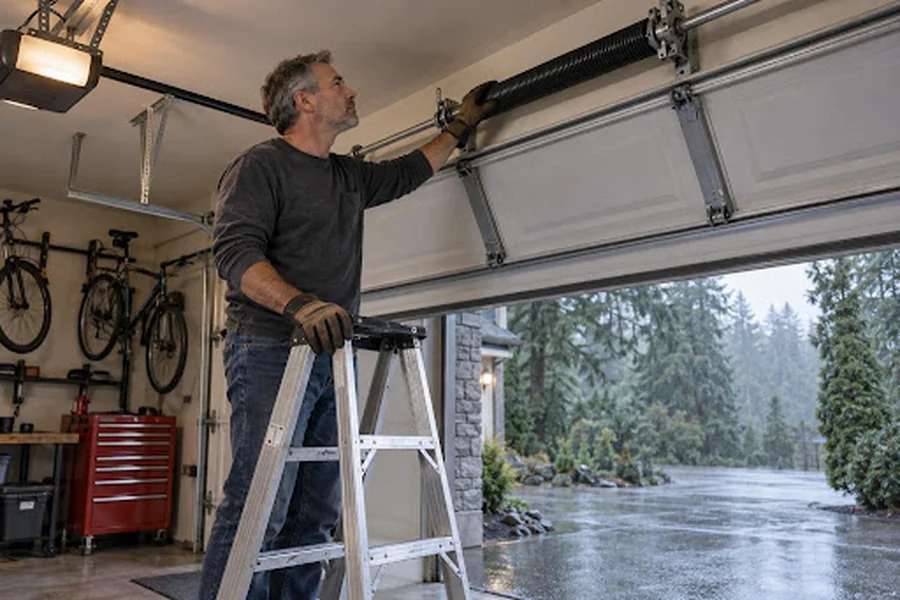
Most modern residential doors use torsion springs mounted on a steel bar above the opening. As the door closes, the springs wind up and store energy; as it opens, they unwind and release it. Older and lighter doors often use extension springs instead, which stretch along the horizontal tracks on each side.
Every spring is rated for a number of cycles, and one opening plus one closing counts as a single cycle. Standard springs are commonly rated around 10,000 cycles. A household that uses the garage as its main entrance can easily run four or five cycles a day, which adds up to several years of service rather than the life of the house.
What the Eastside climate adds
Kirkland and the surrounding Eastside neighborhoods sit in a damp maritime climate with a long wet season. Moisture encourages surface rust on bare steel springs, and rust adds friction between the coils and creates small weak points where a crack can start.
Cold matters too. Steel is less forgiving at low temperatures, and many failures happen on the first chilly mornings of the season, when a spring already near the end of its life is asked to lift the door one more time. Garages tucked into sloped lots, a common layout on Kirkland’s hillsides, tend to stay cool and humid all winter, which speeds up both problems.
Warning signs before a spring breaks
- The door feels heavier than it used to when lifted by hand
- A visible gap has opened between coils on a torsion spring
- The door rises unevenly, with one side lagging behind the other
- The opener labors, slows down, or reverses partway up
- Rust is visible along the coils or a spring looks stretched
A simple balance test tells you a lot, but only when both springs are visibly intact. With the door fully closed, pull the emergency release cord, lift the door by hand to about waist height and let go carefully. A balanced door stays roughly where you left it. One that drops quickly or drifts upward has springs that are worn or out of adjustment. If a spring is already broken, leave the release cord alone and keep the door shut.
Why spring work is not a weekend project
A wound torsion spring stores enough energy to cause serious injury. Replacing one safely requires proper winding bars, the correct wire size and length for the weight and height of the door, and experience. Door manufacturers state plainly in their manuals that spring adjustment belongs to trained technicians.
When you call for garage door repair in Kirkland, a proper spring replacement covers more than the spring itself. Expect the technician to match the new springs to the door, replace both springs on a two spring system so they wear evenly, inspect the cables and drums, lubricate the moving parts, and finish with a balance check and a safety reverse test on the opener.
It is also worth asking about high cycle springs. They cost a little more but are rated for considerably more cycles than standard ones, which makes sense for a garage that doubles as the family’s front door.
Small habits that make springs last
A light coat of garage door lubricant on the springs two or three times a year slows rust, and a quick look at the coils each October can catch trouble before the cold sets in. Keep the bottom seal and side weatherstripping in good shape too, since a door that seals well keeps the whole garage drier. Local specialists such as Lifetime Garage Door can check springs, cables and seals together during a tune up, which is usually the least expensive way to avoid a surprise failure on a wet January morning.
Quick answers
Can I open the door with a broken spring?
Avoid it. Without spring support the door is extremely heavy and can drop suddenly.
Should both springs be replaced at once?
On a two spring door, yes, because the remaining spring is the same age and rarely far behind.
How long does the repair take?
Typically a single visit of an hour or two once the right springs are on the truck.